Copper's last tricks
Very high rates over very short runs, from a cabinet close enough to matter.
01Distance is the enemy, and cabinets are the cure
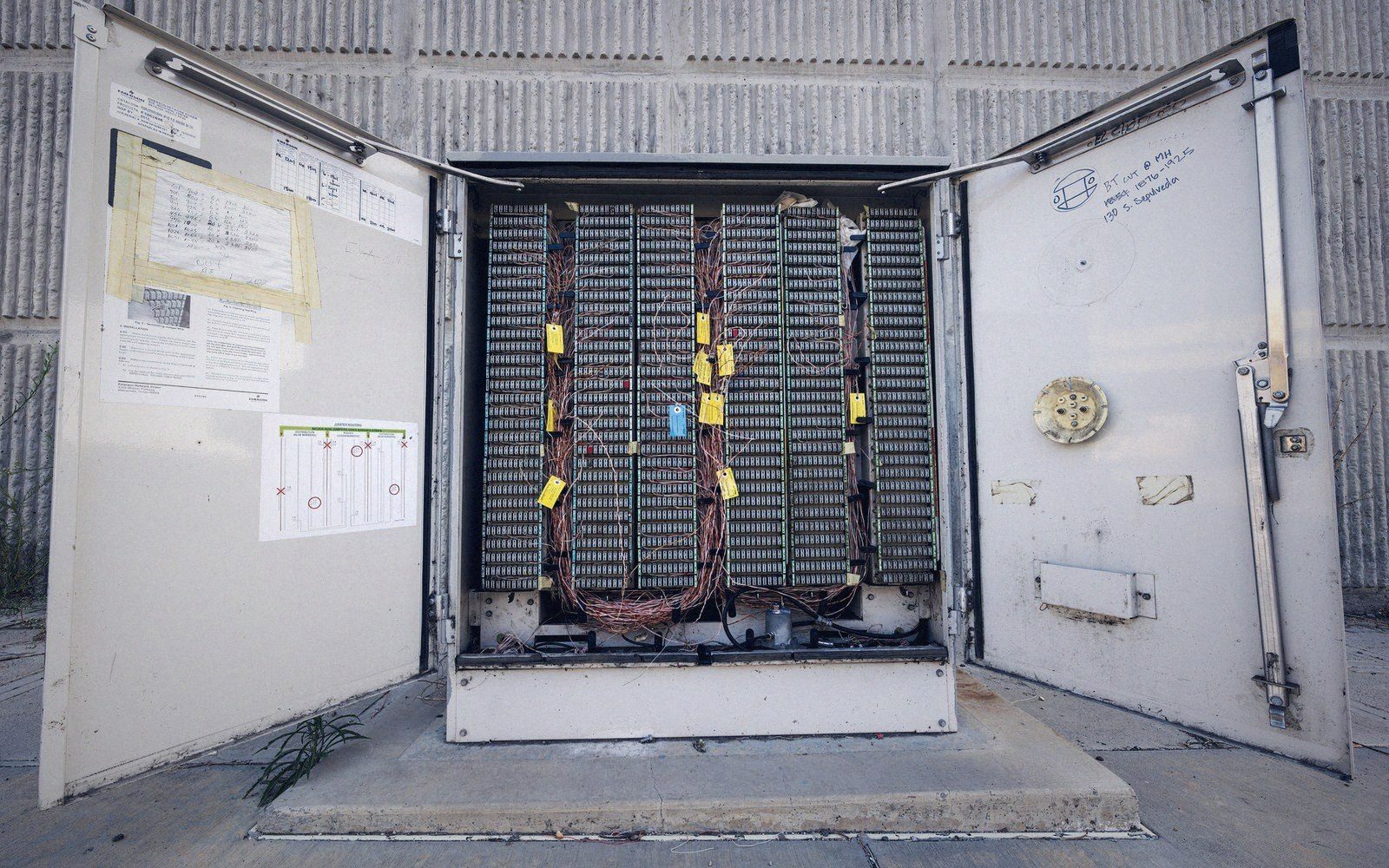
Copper does one thing that fibre cannot: it is already there, running under nearly every street in the developed world. The pair from exchange to premises has been there for decades, and replacing it is expensive enough that operators have spent a generation looking for ways to keep it useful.
The physics is unforgiving. Attenuation rises with frequency, and the frequencies you need for high-speed data are the first to die over distance. A kilometre of copper is a different medium from a hundred metres of copper, and DSL's entire history is the story of closing that gap — not by improving the wire, but by moving the electronics closer to the customer.
VDSL2, deployed from a fibre-fed street cabinet rather than a distant exchange, pushed usable bandwidth into the tens of megabits per second over a few hundred metres. Then vectoring arrived: a technique that models and cancels the crosstalk between pairs sharing the same bundle, recovering signal that would otherwise be lost to interference. Vectored VDSL2 from a well-placed cabinet can sustain well over 100 Mbit/s on a short loop, which is not a consolation prize in a market where most households' actual usage still sits below that.
G.fast pressed further still — frequencies up to 212 MHz, deployment from a building's basement or a pole-mounted micro-node outside the premises, loop lengths measured in tens of metres rather than hundreds. On a twenty-metre run, G.fast delivers gigabit-class symmetrical rates. On a hundred metres it still does several hundred megabits. The node must be genuinely close, which means deploying a lot of small active units and powering them all, and that cost is what makes the calculation difficult.
XG-FAST has been demonstrated in the lab, doubling G.fast's frequency range and touching multi-gigabit rates on very short copper, but commercial deployment remains marginal. The closer the node must sit to make the economics work, the more it starts to resemble the last hundred metres of a fibre build anyway — at which point the honest question is whether you are engineering a copper system or a fibre system with a copper tail you have not yet replaced.
The answer depends on what is already in the ground and who owns it.
The technology ladder
- VDSL2 — DSL variant using frequencies to around 35 MHz; typically deployed from a street cabinet
- Vectoring — active cancellation of crosstalk between pairs in the same cable binder; standardised as ITU G.993.5
- G.fast — frequencies to 106 or 212 MHz; loop lengths under 250 m for useful rates; ITU G.9701
- XG-FAST — experimental extension of G.fast to 500 MHz+; multi-gigabit demonstrated in lab conditions, not widely deployed commercially
| VDSL2 | DSL variant using frequencies to around 35 MHz; typically deployed from a street cabinet |
| Vectoring | active cancellation of crosstalk between pairs in the same cable binder; standardised as ITU G.993.5 |
| G.fast | frequencies to 106 or 212 MHz; loop lengths under 250 m for useful rates; ITU G.9701 |
| XG-FAST | experimental extension of G.fast to 500 MHz+; multi-gigabit demonstrated in lab conditions, not widely deployed commercially |