Fixed wireless
A dish on a gable and a base station in line of sight. It goes in within a day and the weather has opinions about the higher frequencies.

01A beam of spectrum across the gap
Fixed wireless access puts a small antenna on a building and a base station somewhere in line of sight. No trench, no duct, no splice. The customer equipment goes up in a morning and the service is live that afternoon — which is precisely why it gets deployed where fibre lead times run to years, or where the economics of digging simply never close.
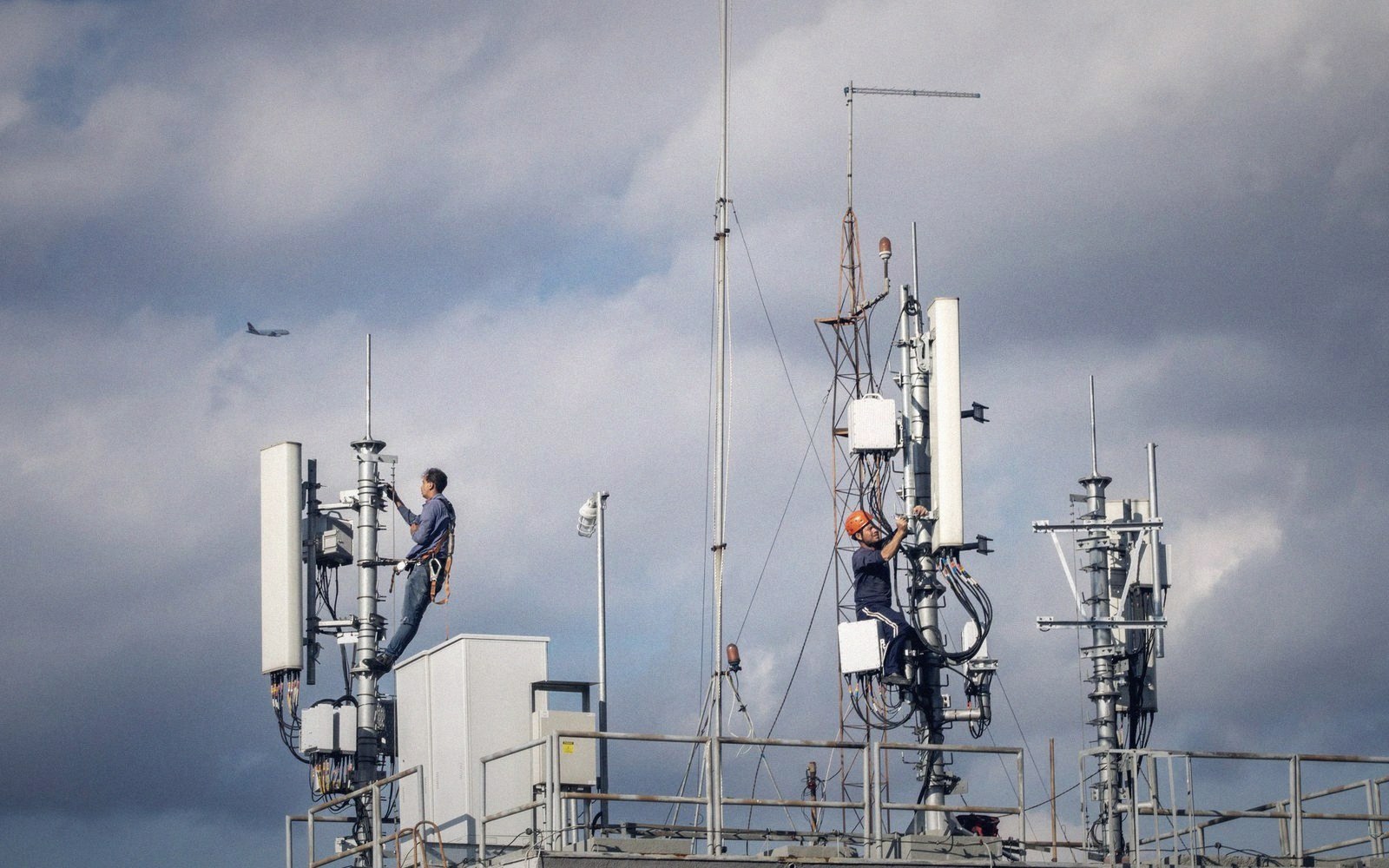
The physics is straightforward: a radio link carries data between two fixed points across open air. The base station — mounted on a mast, a water tower, or a rooftop with a clear horizon — serves a sector of premises, each with a small outdoor unit locked onto it. Capacity is shared across that sector, so the architecture has more in common with one fibre serving many homes through a passive splitter than it does with point-to-point fibre, though the analogy is imperfect. The spectrum is finite, and every subscriber in the beam is a claim on it.
02Frequency, reach and rain
The choice of frequency determines almost everything about a fixed wireless deployment: how far the link can span, how much bandwidth it can carry, and how badly the weather degrades it.
Sub-6 GHz bands — 3.5 GHz is now the workhorse frequency in many licensed deployments — propagate well over several kilometres, tolerate modest obstructions and are largely indifferent to rain. That forgiveness comes at a cost: less available spectrum, lower peak throughput and a crowded regulatory environment. Still, for rural and semi-rural coverage where premises are spread and the nearest exchange is distant, these bands deliver a workable broadband service from a modest tower.
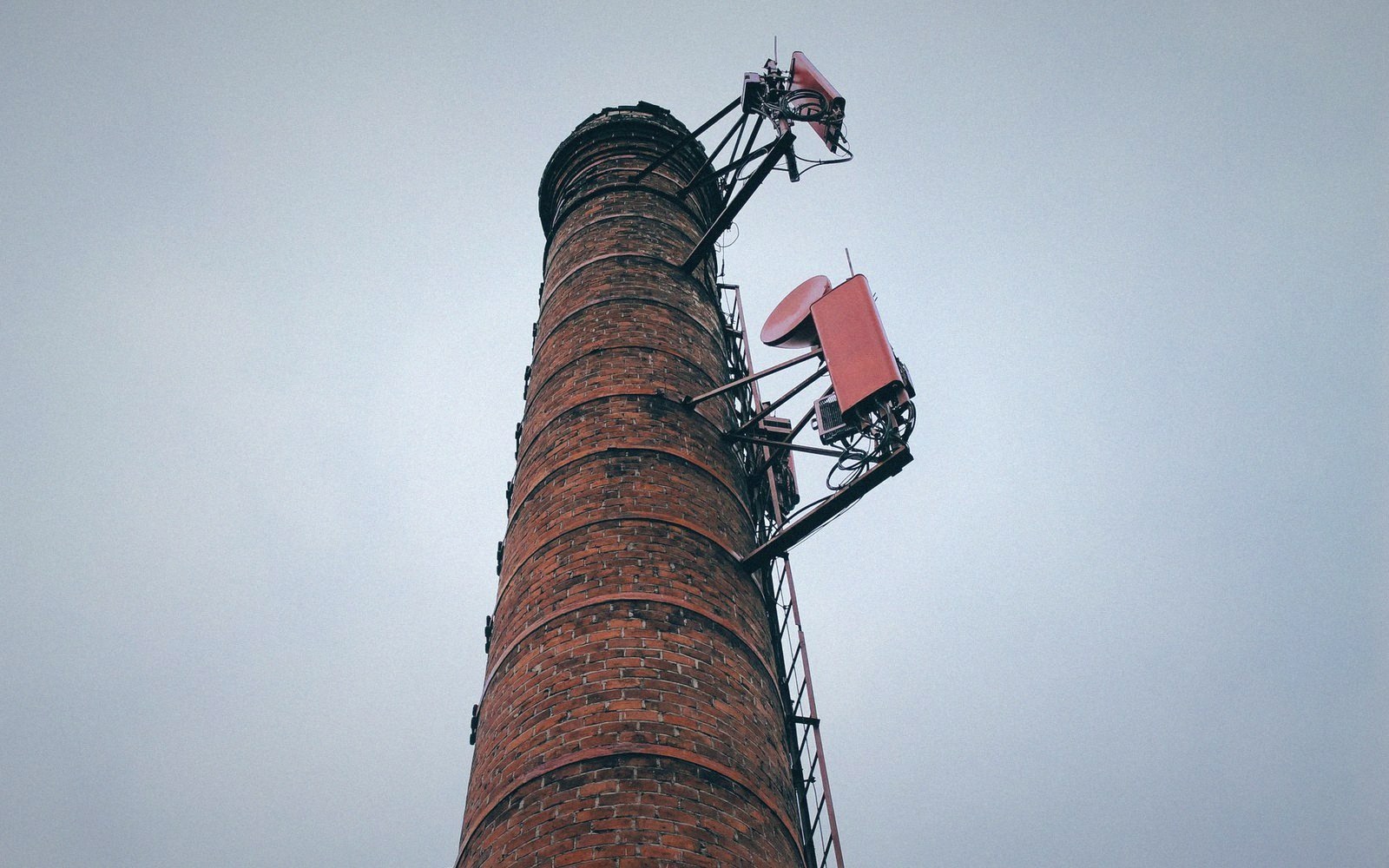
Move into the millimetre-wave bands — 60 GHz, the E-band around 70–80 GHz, and the licensed point-to-point allocations above that — and the calculus reverses. Throughput climbs sharply; a well-engineered E-band link can carry multiple gigabits over a few kilometres. But rain attenuation becomes a real operational concern, not a theoretical one. At 60 GHz, oxygen absorption further limits usable range to a few hundred metres. Fog and heavy precipitation add meaningful dB of loss to a link budget that has no margin to spare. For dense urban deployments where rooftop-to-rooftop distances are short, this is manageable. For rural links with several kilometres between endpoints, the higher frequencies require very careful planning and realistic expectations about availability in wet climates.
Line of sight is the other constraint that operators learn to respect. A clear Fresnel zone — not merely an unobstructed direct line, but the elliptical volume around it that carries the bulk of radio energy — must be kept free of obstructions. A new rooftop structure, a mature tree, or a building going up between base station and customer unit can degrade a link that worked fine at installation. Survey tools and propagation modelling help, but fixed wireless networks do require periodic re-engineering in changing environments.
Key trade-offs by frequency band
- Sub-6 GHz (e.g. 3.5 GHz) — longer reach, rain-tolerant, less throughput, spectrum competition
- 60 GHz — high throughput, very short range, significant oxygen and rain absorption
- E-band (70–80 GHz) — multi-gigabit capable, moderate range, rain attenuation a real factor; used for point-to-point links
- Licensed vs. unlicensed — licensed bands offer interference protection; unlicensed (e.g. 5.8 GHz ISM) are cheaper to access but unprotected
03Where it genuinely wins
Speed of deployment is fixed wireless's most compelling argument. A fibre rollout to a rural community involves wayleave negotiations, trenching, ducting, cable-pull, splicing and commissioning, measured in months at best. A fixed wireless network can be operational in weeks from the point a suitable site is secured for the base station. For communities in that gap — serviceable but not yet served — that difference is not trivial.
The cost structure is also different. Civil works dominate fibre budgets; a deep rural trench can run to tens of thousands per kilometre before a single cable is pulled. Fixed wireless concentrates spend on the base station, the backhaul to connect it, and the customer units, with no per-metre ground cost between them. Where homes are scattered and distances long, that model holds up well.
Line of sight is the other constraint that operators learn to respect.
Beyond Fibre · Fixed wireless
What it does not do well: deliver guaranteed symmetric gigabit throughput to dense populations reliably over many years without repeated spectrum re-farming and equipment upgrades. Fibre's capacity scales with technology deployed at the ends; fixed wireless capacity scales with the spectrum available, which is finite and contested. Most operators treat it as a complement to a fibre rollout programme — a way to reach premises before fibre arrives, or premises that fibre will never reach economically — rather than a permanent substitute.
The dish on the gable works. It just has opinions about rainclouds, and the base station has opinions about how many neighbours are sharing the beam.
Where fixed wireless fits the build plan
- Rural and semi-rural areas where civil costs make fibre economics unworkable
- Interim service before fibre rollout reaches a community
- Premises that will never justify a dedicated fibre drop
- Rapid deployment scenarios — operational within weeks, not months