Point-to-point instead
When every premises gets its own strand, the splitter disappears — and so do the arguments about it.
01One strand, one customer
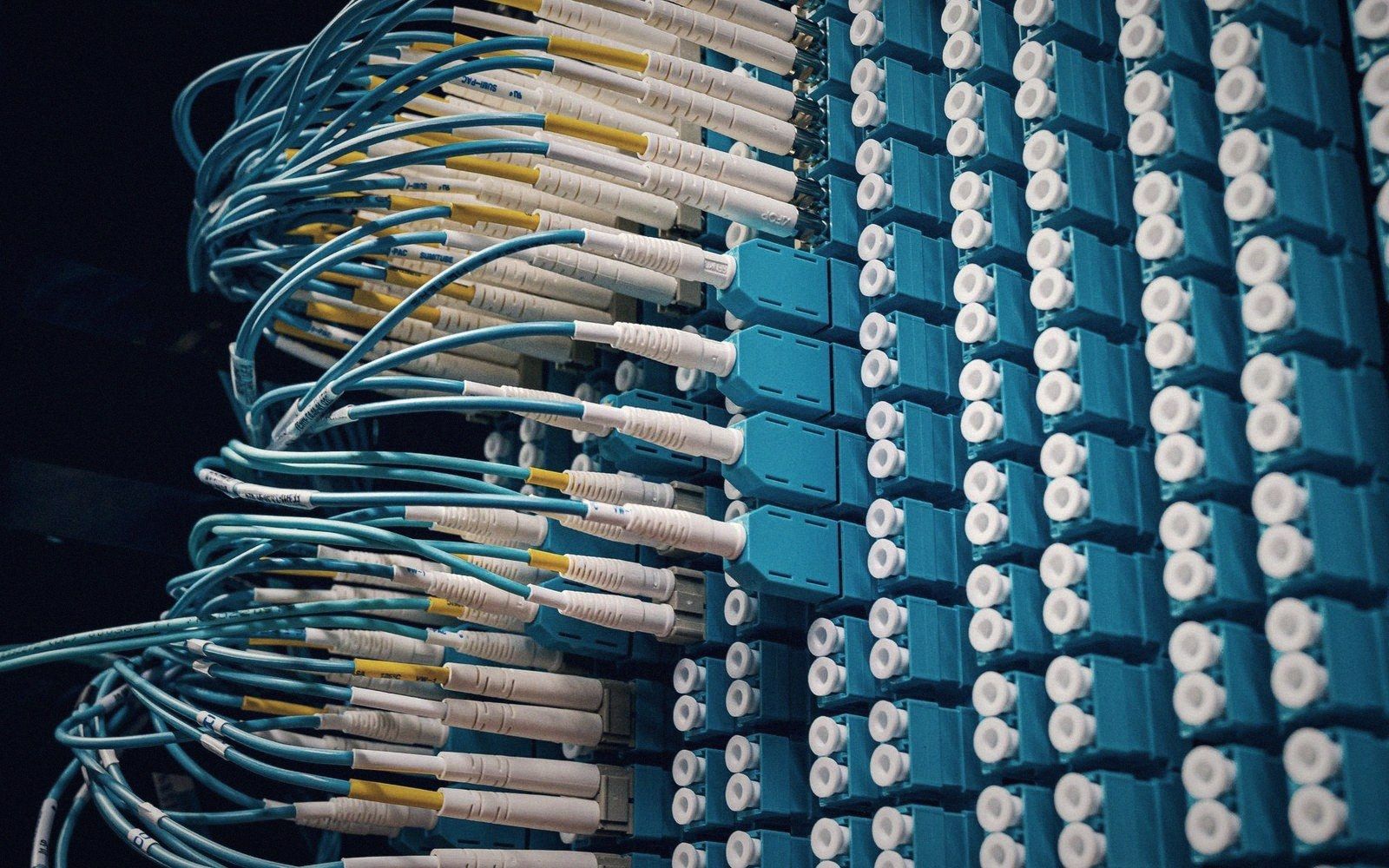
Passive optical networks dominate access network planning because a single feeder fibre, split passively, serves dozens of homes. The economics are obvious. But the split ratio is a commercial decision that carries real costs: every doubling of the ratio eats roughly 3.5 dB of optical budget, and every doubling costs light and shares capacity in ways that eventually limit both reach and peak throughput. Point-to-point active Ethernet — one dedicated fibre run from exchange or street cabinet to each premises — sidesteps every one of those constraints by removing the splitter entirely.
The optical budget argument alone is compelling in awkward deployments. Without splitting losses to absorb, a point-to-point link can run further on the same transceiver power, or use cheaper optics on a shorter run. There is no shared medium and therefore no downstream contention: each customer's fibre carries only that customer's traffic. Fault isolation is exact — an OTDR trace identifies a break to within a metre on a known, dedicated path, rather than requiring you to work through a branch of a passive tree.
Where the trade-offs land
- Optical budget — no splitting loss means longer reach or cheaper optics on short runs
- Contention — point-to-point has none; PON shares downstream capacity across the split ratio
- Fault isolation — a dedicated strand returns a single clean OTDR trace; a PON branch requires working through the tree
- Upgrade path — swap transceivers at both ends; no shared line card headroom to model
- Fibre count — one strand per premises means high fibre count in the feeder duct
- Active electronics — required at each premises end, versus one passive splitter node serving many
- Best fit — business parks, campus networks, open-access bitstream environments, high-SLA customers
Congestion management disappears as an engineering problem, because there is nothing to congest. Upgrades are symmetric and straightforward: swap the transceiver at both ends and the service tier moves with it, independently of any neighbour. That simplicity matters at scale; provisioning a new speed tier does not require modelling shared-medium headroom or coordinating with a PON line card that serves thirty other customers.
02Where the extra glass is worth paying for
The cost objection is real. A point-to-point network needs a strand of fibre per premises all the way back to an active node, which means a much higher fibre count in the feeder — and active electronics at each end rather than a passive splitter in a field enclosure. The duct requirement does not shrink; micro-duct and blown fibre can pack many strands in a single tube, but you still need more of them. In dense urban deployments the economics rarely favour it over PON; in a business park, a hospital campus, a multi-tenanted data-centre campus or any environment where customers routinely buy symmetrical gigabit or higher — and where a network operator is selling differentiated SLAs — the per-strand model pays for itself in simplicity and in the premium pricing those customers will sustain.
It also suits competitive environments. Where open-access network operators must offer bitstream to multiple retail ISPs over the same infrastructure, a dedicated-fibre model makes service separation cleaner at the physical layer: there is no shared PON frame to partition, no need to negotiate VLAN stacking or wavelength assignment with a splitter that does not care.
The glass costs more. The arguments cost less.

| Optical budget | no splitting loss means longer reach or cheaper optics on short runs |
| Contention | point-to-point has none; PON shares downstream capacity across the split ratio |
| Fault isolation | a dedicated strand returns a single clean OTDR trace; a PON branch requires working through the tree |
| Upgrade path | swap transceivers at both ends; no shared line card headroom to model |
| Fibre count | one strand per premises means high fibre count in the feeder duct |
| Active electronics | required at each premises end, versus one passive splitter node serving many |
| Best fit | business parks, campus networks, open-access bitstream environments, high-SLA customers |